There is a quiet truth that sits beneath much of modern life, and once you see it, it becomes difficult to ignore:
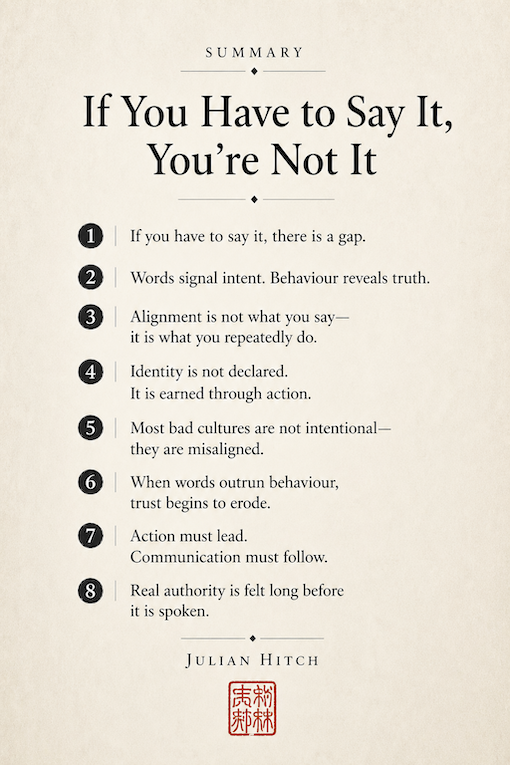
If you have to say it, you’re not it.
We live in a world where signalling has, in many ways, overtaken substance - where the language of identity is often louder than the reality of behaviour. It is increasingly tempting to declare what we are, rather than to become it. And yet, mastery does not work like that. It never has.
At its core, this is a question of alignment - between what you think, what you feel, and what you do. In the language of Eastern philosophy, it is the integration of the three centres: the head, the heart, and the body. In Wing Tsun, it is expressed through movement. Not through words, but through action. Not through intention alone, but through embodiment. This is because action reveals what words attempt to conceal.
I saw this very clearly during my time at Leon Restaurants. There was always a temptation -as there is in any organisation - to lead with initiatives, to launch programmes, to communicate values, to tell the world who we were. But we learned something important: if it does not live in the behaviour first, it will not live at all.
So we resisted the urge to declare before we had demonstrated. We focused instead on making it real - on ensuring that what we said was already true in practice, not something we hoped might become true through repetition. It’s clear the world does not lack for words; it lacks for congruence.
There is also a quieter frustration that sits beneath much of modern business. Even when you are willing to pay well, when price is not the issue, it is still surprisingly difficult to find people who simply do what they say they will do. On time. To standard. Without complication. That tells you something important: there is no shortage of promises, but there is a shortage of delivery.
You can see the opposite everywhere. In the language of “greenwashing,” where organisations speak loudly about sustainability while behaving in ways that contradict it. In leadership, where individuals describe themselves as “authentic,” “empowering,” or “values-led,” yet operate in ways that undermine those very claims. And in individuals, where there is a reliance on telling others who they are, rather than allowing that truth to emerge through consistent action. But this is not a new challenge - Confucius put this precisely, when he stated ‘the superior person is ashamed when his words exceed his actions’.
Often, this is not malicious; it is insecurity. It is the need to be seen as something before one has fully become it. And in some cases, the gap does not close, because the person is not willing, or not suited, to do the work required.
Mastery moves in the opposite direction. It is quieter, more deliberate, less concerned with declaration and more concerned with demonstration. Real capability does not need to announce itself. It is felt, understood, recognised.
My father used to express this in simpler terms: talk is cheap. At the time, it sounded almost too obvious to be meaningful. But over time, I have come to see the depth within it. Because talk does sell. Marketing works. Positioning works. Words can open doors. But good marketing can create the appearance of something that is not yet real - it cannot sustain it. What behaviour does not support, reality eventually exposes. And over the long run, it is behaviour that determines trajectory. Hype is intoxicating but mastery is enduring.
There is also a subtle inversion here that is often missed. Many people believe that identity comes first, and behaviour follows - that if they say “I am this,” they will become it. In reality, it is far more often the reverse. You become something through intentional repeated action, and only then does the identity emerge - quietly, almost incidentally.
This is why, in Wing Tsun, we train this concept through movement. Movement bypasses the illusion. You cannot pretend to have speed - you either have it or you do not. You cannot claim sensitivity - you either feel it or you do not. You cannot talk your way into timing, balance, or presence. You must become it.
In martial arts, this becomes undeniable. You cannot tell someone you are skilled - you either are or you are not. Reality does not listen to your words; it responds to your capability. And sooner or later, you will be tested. Life will give you the punch, and when it does, no negotiation will stop it.
This extends far beyond martial arts. In business, in leadership, in life - if you have to repeatedly tell people that you are disciplined, or kind, or strong, or authentic, then there is a gap. Not necessarily a failure, but a gap between what is said and what is lived. And over time, that gap does not remain neutral. It erodes trust - both in others and in yourself.
This is not an argument against communication. Clarity matters. Language matters. Marketing matters. But they must follow reality, not attempt to replace it. The order is everything: action first, voice second. Most people try to speak their way into identity. Masters act their way into it.
When that order is reversed, something subtle happens. You begin to believe your own words, and in doing so, you reduce the pressure to actually live them. The identity becomes performative rather than embodied, and over time, that gap widens. Whereas when action leads, something else emerges: credibility, trust, a quiet authority that does not need to assert itself because it is already visible.
This is where power is often misunderstood. It is not something you declare, and it is not something you are given. It emerges - from consistency, from action, from alignment, from who you are and what you repeatedly do. This is what creates presence, gravitas, authority. Not performance, but embodiment.
So the question becomes a simple one: are you telling people who you are, or are you showing them?
In the end, the world is not shaped by what we say we are. It is shaped by what we consistently do. And the irony is this: when you truly become it, you rarely feel the need to say it at all. Humility and presence flows naturally from this.
So perhaps the real question is not what you say you are. It is this:
Where are you still speaking - because you have not yet done?
And where could your actions lead - before your words ever need to?
Julian Hitch