One of the greatest lessons from martial arts is not how to fight. It is how to understand risk - and deal with it appropriately.
And that is something most of our education system fails to teach.
I began Wing Tsun Kung Fu at fifteen, but I was also shaped by my father’s generation - people who had lived through the bombing of London, served abroad in the Army during World War II, and who understood, not intellectually but viscerally, that life can change quickly and without warning. I have also spent significant time in Eastern Europe and other parts of the world where that reality is not theoretical, but lived.
One of the things I am very aware of is the position much of the modern West is in. Many of the wars, conflicts, and existential pressures are not literally on our doorstep, although something like the conflict in Ukraine reminds us how quickly that assumption can be challenged. But there is a broader point here, which is that one of the things Wing Tsun learned over its long history is that life changes, and it can change very quickly.
We know this in business. We saw this in COVID. And we see it in politics, conflict, health, and society. The real question, therefore, is:
How do we understand risk?
In the West, we often get stuck on what we like and do not like, rather than what risk actually is and how it behaves. That matters, because if you sanitise too much risk, and do not understand how to do difficult or dangerous things appropriately, then when things do go wrong, you do not have the skill set to deal with them. In fact, you often have an inappropriate stress response, which makes the situation worse.
You Are the Technology
An excellent illustration of this in the military. There is always a temptation to rely on technology. And rightly so - technology saves lives. But the moment you enter a room personally, the moment something goes wrong, the moment the plan breaks down, you are the technology. And if that capability has not been trained, it does not exist when it is needed.
I have seen this directly in my work training soldiers. Close-quarter-combat is not the whole of military training, nor should it be. However, that does not mean it should be ignored, as it often is. When a core capability is no longer regularly exercised because technology, distance, or systems appear to reduce the need for it, that capability can steadily erode. And when it is needed again, it is too late to wish it had been preserved.
If I take the British Army as an example, close-quarter-combat competency was far stronger during the Northern Ireland era, where there was both the practical need for it and a level of continual exposure that sharpened those skills. Over time, as operational priorities shifted, that competency was not always emphasised in the same way – until little of it remained. My training aims to fill the hole – but the greater learning is that if that capability has been sanitised out because it feels uncomfortable, then fragility has been built where resilience should have been.
Trained consistently, however, this expertise compounds – even if not a main focus. And this is where the understanding of risk in this context lies; you might train for years and never need it – but in a split second this training can save your life.
The Paradox of Over-Sanitisation
Comfort is often the early signal of future risk.
There is a paradox here. In trying to remove risk from life, we often create a deeper fragility. Without exposure to pressure, we do not develop the capacities that allow us to deal with it. We do not build the judgement, the timing, the coordination, the calmness, the mental fortitude, or the speed of action.
And there is another layer to this: when people become aware of risk, they often do not simply respond to it wisely. They overcorrect. Human beings have a tendency, particularly when stimulated into fear, uncertainty, or a fight-flight response, to go to extremes. We do not simply avoid risk; we often swing too far the other way - and create more problems later on.
A powerful example of this was during COVID.
Handwashing and hygiene matter. But there came a point where behaviour tipped from sensible precaution into compulsion. Constant hand sanitiser use, repeated far beyond what was necessary, was not going to magically stop you from getting ill, but it could and did create downstream consequences of its own - skin irritation, barrier damage, and broader concerns around disturbing the microbiome and negatively impacting the immune system. At some stage, the attempt to eliminate one risk starts to create another.
Your response to risk needs to be proportionate to the reality of the situation. We want absolutes - but risk does not work in that way. It is ever-changing. As we say in Wing Tsun, “What may be true today, might not be true tomorrow.” Because when proportionality disappears, discernment usually goes with it. And indeed, sanitising yourself can become a risk in itself.
Disconnection from the Natural World
The more you try to remove risk, the more dangerous life becomes for you.
We see this not only psychologically, but biologically. Children today have far less contact with the natural world than previous generations. Less time outside. Less soil. Less mud. Less contact with animals, weather, mess, and the actual physical realities of life.
Back in the 1950s, many more people grew some of their own food, touched the land, handled animals, and lived in direct contact with the environment that sustained them. Today, particularly in cities, many people can go for long periods without touching soil at all in any meaningful sense. That matters, because we have evolved to need biological exchange.
I remember having a funny conversation with my daughter when she was about three. I looked around while working on the farm and saw that she was eating mud at our farm, something I am sure many parents can relate to. I said, “Darling, don’t do that. That’s not good.”
And she looked at me and said with total confidence, “It is good, Daddy.”
Now, on one level, it was hilarious - and pretty nasty. But on another level, there is something in it. We have become so disconnected from the natural world that mild contact with it now seems abnormal. She was, of course, fine - and, as many studies now show us, exposure at a young age can make us much stronger. While I would not recommend her eating it, at the same time it is important to understand the risk.
The issue here, therefore, is not recklessness. The issue is disconnection.
Facing Risk, Not Feeding Fear
There is another paradox at the heart of risk. By avoiding risk, you often make the consequences more likely.
In Wing Tsun we see this very clearly. If you are worried about an opponent’s punch, you are more likely to get hit. Why? Because your awareness narrows. You freeze around the threat. Your nervous system contracts. You are not seeing clearly. You are not responding appropriately. Instead, you are focusing on the problem, and in doing so you create the result of the very thing you fear.
Whereas if, instead, you are focused on how to deal with the situation - if you train to have the right skills, mindset, and behaviours to meet it - then your ability to effectively defend it changes entirely. In Wing Tsun we call this principle Chu Ming: face-to-face (and we write more about this in Winning Not Fighting).
This does not mean fear disappears. But it does mean you get greater control over your fear response - and, most importantly, it means that fear does not get to determine your action. And that is one of the most important things in this whole subject:
Fear should not determine your decision.
Instead, the real question is:
What is the appropriate action in that moment?
Whether you like it or not is irrelevant. Whether you wish it were different is irrelevant. Whether it should be happening, morally speaking, may matter in one sense - but in the moment, reality is asking a different question. Instead, you ask: What is the right response, now?
The Middle Line Between Softness and Extremity
An example of going too far to the other extreme comes from my own family. My uncle, preparing for the Second World War, described an exercise where soldiers had to run up a mountain in Wales with fixed machine guns firing live rounds. The lesson was simple: keep your head down. The consequence if you did not was death. They apparently had an accepted casualty rate of around 20%.
Now, in my view, the balance of learning versus risk there was weighted completely wrongly. It was not intelligent training or calibrated exposure. It was just unnecessary loss. But the fact that one extreme is foolish does not mean the opposite extreme is wise.
And this is one of the great errors we make in modern society. We often respond to excess not with balance, but with reversal. So if brutality was stupid, we swing to sanitisation. If danger was mishandled, we swing to overprotection. If risk was excessive, we act as though risk itself is the problem.
That is why Wing Tsun teaches the middle way - or centreline, as we call it. Not too sanitised. Not too extreme. The aim is to stop the wild swinging from inappropriate risk-taking to trying to make there no risk at all. Instead Wing Tsun aims to provide a more graduated, intelligent approach.
Training Risk, Not Removing It
Risk is something that needs to be continually trained. If I get my students to train on traditional training poles, I do not start them on eight-foot poles. I start them on one-foot poles, then three-foot poles, then five-foot poles, then eight-foot poles.
Why?
Because the point is not to remove risk. The point is to build competence. And to build the nervous system’s ability to stay calm and coordinated in a progressively more demanding environment. Some risks are unacceptable. Some are necessary. The key is knowing the difference and knowing the timing.
Positive Preparation
My Wing Tsun teacher, Grandmaster Máday Norbert, who grew up in Hungary under a brutal communist regime, used to say, half joking but not really: “Life is brutal and full of traps.” That is perhaps at one end of the spectrum. He also used to say: “You only own what you can put in your pockets.”
Again, that can sound severe, even paranoid, to modern ears. But it came from a lived reality. It came from a world where systems could change quickly, freedoms could disappear, and assuming permanence was a luxury.
These are not ideas to live inside permanently, but they are worth understanding. In business, Jim Collins called this productive paranoia. In Wing Tsun, we put this slightly differently:
Prepare for the worst. Create the best.
For Wing Tsun that is the middle line. Not survivalist catastrophe-thinking, where you live in a bunker waiting for the world to fall apart. And not delusional fantasy, where you imagine reality will conform to your preferences because it feels nicer to think that way. Practical training that enhances your everyday life – but covers you should things go an unexpected direction.
Naivety, Fairness, and Self-Responsibility
Something I see a lot in life is the comment:
“Well, it shouldn’t happen.”
While that might be true, it is dangerous to abdicate your responsibility to mitigate risk. As an example, you should not be attacked as a principle of a civilised society. However, that does not mean you should walk through a place with high crime, unaware, distracted, with headphones in, because you are assuming reality will honour your moral preference.
This is where self-responsibility matters. Not in the sense of blame, but in the sense of not externalising your safety and your awareness entirely onto others.
We all want life to be fair. But there is a profound difference between valuing fairness and assuming reality will always behave fairly. As my father used to say: there are many people who were right who are in the grave.
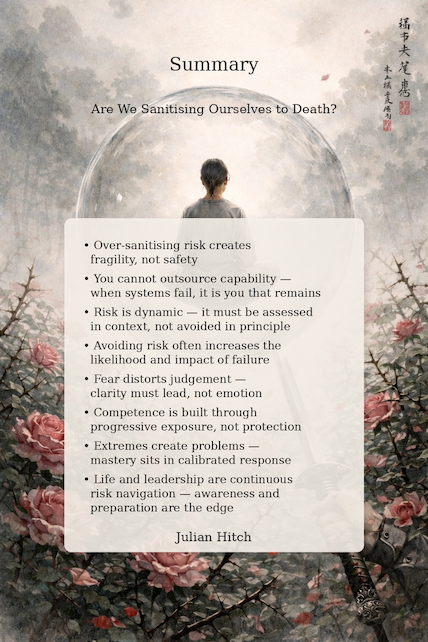
Mastery in life is not built on what should happen. It is built on being prepared for what might.
A Dynamic Understanding of Risk
To take your understanding of risk to the next level you need to understand that risk is not static. It is dynamic. It changes according to the situation, the state you are in, who you are with, what environment you are in, and what your level of skill is.
For me, the understanding of risk comes down to four overarching aspects:
1. You have to understand risk to be able to minimise it.
2. Ignoring risk often makes it more likely to happen.
3. Risk is dynamic - the situation, your state, and your environment all determine how you should act.
4. Risk is reduced by appropriate exposure and skill set.
This is something I explore in more depth in later writing.
Life Is Continuous Risk Navigation
Life, in many ways, is about how to deal with risk. It is a continual, moment-to-moment experience:
• How you cross the road
• Who you trust - and why
• How you communicate under pressure
• What decisions you make - and when
• Where you place your attention
• How you respond when conditions change
No one is exempt from this. Not an emperor. Not a gardener. Not a soldier. Not a child. Not a founder. The only real difference is awareness, preparation, and skill.
Final Reflection
So the real question is not: How do I eliminate risk from life?
It is: How do I understand risk well enough to deal with it appropriately?
So perhaps, in your own life, it is worth taking a moment to ask: where do you over-sanitise your life - and where could you build the skills to deal with greater risk more intelligently? Because risk is not going away.
The only question is whether you are prepared for it - or protected from it until it is too late.
Julian Hitch