Most organisations spend a significant amount of time thinking about how to motivate their people.
Better pay. Better perks. Better structures. Better incentives.
And yet, despite all of this, engagement drops, performance plateaus, and the same conversations continue. So there is a more fundamental question that sits underneath all of this.
What if the problem is not how well you motivate people…
But that you are building a system that requires constant motivation in the first place?
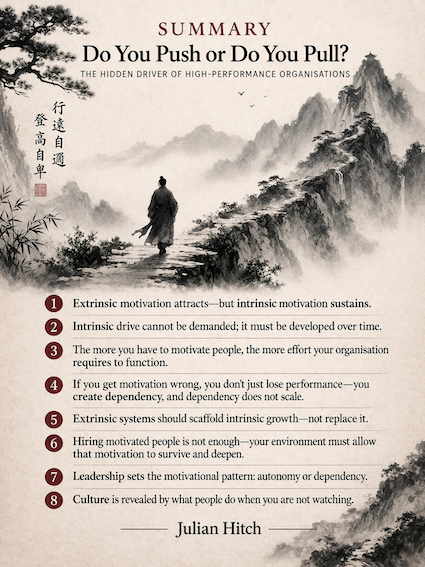
Because if you get this wrong, you don’t just lose performance - you create dependency. And dependency increases effort without a corresponding return. It does not scale.
When you look at how to create high-performance organisations, there are a multitude of different factors. How the organisation is structured. The levels of promotion. The perks that people receive. Pay. The environment. The language that is used. All of these matter. And they matter more than people sometimes realise.
But there is a more fundamental layer underneath all of this that most people don’t necessarily see. And for me, this is where mastery becomes the key to unlocking human potential - both in individuals and in organisations.
The Two Forms of Motivation
At its simplest, this comes down to something that is well established in psychology. We are driven by two forms of motivation.
There is extrinsic motivation, which is driven by external rewards and pressures. And there is intrinsic motivation, which is driven by internal satisfaction - by growth, by meaning, by the experience of improving itself. To make this practical, I often think about it as push and pull.
Extrinsic motivation is driven by external pull. Titles, pay, perks, recognition, the people around you, the way you are treated, the environment you are placed in, the language that is used around you.
Intrinsic motivation is something very different. It is the drive to improve because improvement itself is rewarding. It is the desire to grow, to refine, to understand, to become. And one of the most powerful drivers within that is the simple experience of growth itself.
This is the shift from pull to push -the movement from externally driven performance to internally generated performance.
This is where most organisations get this wrong - not through lack of intent, but through misunderstanding the process. They talk about intrinsic motivation as if it should already exist. They say people should take ownership. People should be driven. People should care.
But, here is the key: intrinsic motivation is not something you demand. It is something you develop. And if you don’t develop it, then what you are really doing is building a system that relies on constant external pull to function. The more you have to motivate people, the more effort your organisation requires just to maintain performance.
This is where Wing Tsun provides deep wisdom as a model of development. This is because what you see in martial arts is a structured process that reflects how human development actually works.
At the beginning, the role of the teacher is to attract the student. People come in for different reasons - fitness, self-defence, confidence, energy, community. At that stage, the teacher must be motivational. You structure the classes well. You give feedback carefully. You recognise progress. You create an environment that people want to return to. Grades and progression help because they make growth visible. This is largely extrinsic - and it is necessary.
As the student develops, however, something must shift. At a certain point, you are no longer teaching students - you are teaching teachers. And eventually, you are guiding masters. At that level, performance no longer comes from external pull - it comes from internal push. People train because they want to improve. They show up because it matters to them. They are not managed into performance - they generate it themselves.
This is where true high performance exists - not when people are driven by the system, but when they begin to drive themselves within it.
So the role of leadership evolves. At the beginning, you create the pull. Over time, you cultivate the push. One of the most common mistakes in organisations is expecting that internal drive without having built the conditions for it.
The aim is not to remove extrinsic motivation. It is to use it properly. Extrinsic motivation should scaffold intrinsic motivation, not replace it. You create the environment. The opportunities. The feedback loops. The visibility of progress. The vision.
And then individuals meet that environment and grow within it - until the motivation increasingly comes from within rather than from you.
This also shows up very clearly in how organisations hire.
We often hear phrases like “cultural fit” or “we want self-starters.” Whilst the intention is right, in practice this can become vague, and at times even biased, because what people often end up selecting for is familiarity rather than capability. What you are really looking for is not someone who simply fits, but someone who can meet the energy of the organisation and grow within it.
It’s important to know that motivation is not fixed. Even highly driven individuals will regress if the environment does not support their development. Hiring is only the beginning. The real question is whether the organisation creates the conditions for that initial motivation to become internal, sustained, and self-directed over time.
If you want to win with less effort, as we talk about in Winning Not Fighting, then you have to help people empower themselves. The more people rely on you to motivate them, the more effort it takes to sustain performance. But when people begin to generate that motivation internally, something changes - effort reduces, performance stabilises and growth compounds. And importantly, performance no longer depends on your constant presence.
This is also where organisations struggle with longevity. Most do not sustain top-level performance over time. Research on the S&P 500 shows that the average lifespan of leading firms has reduced significantly over the last decades.
Maintaining excellence is rare - and one of the reasons is not simply strategy. It is the inability to continually develop people. Adaptation is not, at its core, a strategic problem. It is a human one. So the real question becomes simpler, but more demanding:
How do you create an organisation where people continue to learn, continue to grow, and continue to develop themselves - not because they are told to, but because they want to?
Sometimes this is not complicated. It’s worth observing:
Do people have space to reflect?
Do they consciously track what they are learning?
Are they encouraged to be curious?
Are they given opportunities to improve, not just perform?
Even something as simple as asking someone to spend time each week reflecting on what they have learned begins to shift this. Growth becomes conscious. And over time, it becomes internal.
It is at this point where many organisations unintentionally undermine themselves. They say they value growth, curiosity and development - but where is it actually built into the system? Simply put: Where do you reward learning?
In your reviews, do you ask: what have you learned? What is new? How have you developed your understanding of your role, your craft, your industry?
Is that a weekly conversation? A monthly one? Or is it absent entirely? If it is not part of the mechanism, then something else will take priority. It always does. The question is not just whether you value intrinsic motivation - it is whether your systems allow it to emerge - or quietly suppress it.
And this is where leadership becomes very clear. When we talk about leaders must lead by example, this is why. Leadership does not just set direction, it sets the motivational pattern of the organisation. If you are driven primarily by external reward, pressure, or validation, then your organisation will learn to operate in exactly the same way. And if that is the case, what you are building is not ownership - it is dependency.
A very simple barometer of culture is this: What do people do when you are not watching?
That is where intrinsic motivation either exists - or it does not.
So the question is not whether you motivate people well. It is whether you are building people who no longer require your motivation. And in your own life, the same question applies.
How much of what you do is driven by external pull - recognition, reward, environment? And how much is driven by internal push - the quieter, more consistent desire to grow, to refine, to become?
As a leader that balance is not just personal. It is exactly the balance your organisation will reflect.
Julian Hitch