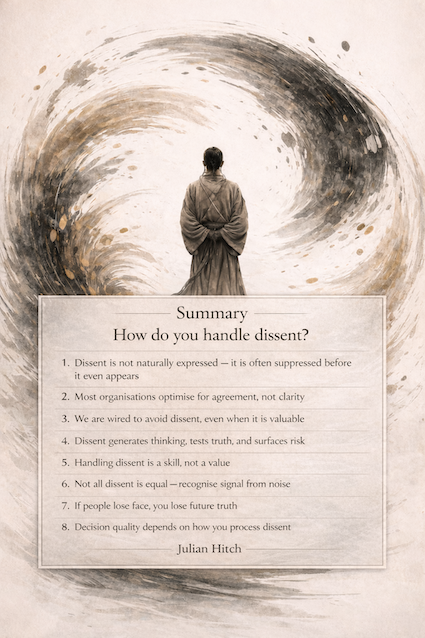
A key to your success in business, and your longevity within it, is your ability to deal with opposing opinions and direct challenges.
It’s one of the biggest challenges I see when working with companies and senior leaders. Those who can genuinely see viewpoints that are completely different from what they believe are the ones who have the greatest adaptability to unseen situations and build the strongest learning cultures.
One of the things that has always been clear is that a core competitive advantage for any business is its ability to learn quickly. But to do that, you have to be able to see different points of view.
And that requires dissent.
The Martial Blueprint: From Line to Sphere
In Wing Tsun, you are taught to understand dissent physically. You start by standing straight and building a 180-degree awareness. Your focus is direct. You can see where you are going, and your perception allows you to recognise anything that may take you off your path.
Then, in the second form, Chum Kiu, your awareness expands to 360 degrees. What is around you? What are you not seeing? What other factors are now in play, and how do you use them?
Then the third form, Biu Jee, adds another dimension - up and down - teaching you to expect the unexpected and respond immediately. What begins as a straight line becomes a sphere.
You now have a full range of movement, adaptability, and perception. And all of this comes with an understanding: ignoring dissent, in this case physical, carries a serious risk of harm. So what is a life skill is first taught as a physical skill.
I’m sharing this because this is not just martial development. It is cognitive development.
The ability to hold multiple perspectives simultaneously is what allows true adaptability. The ancient masters in Wing Tsun recognised that to develop in life, you must be able to deal with things you don’t like, don’t agree with, but still need to understand.
Why Most Organisations Fail Here
Most people believe they are open to dissent. Very few are when it challenges something they have already decided. Most companies simply don’t have a framework for handling dissent.
There is also a deeper tension at play. We tend to like people who are like us. People who think in similar ways, communicate in familiar patterns, and are easy to align with. And yet, creative solutions rarely come just from sameness. They come from difference.
Dissent serves more than one function. It is generative, in that it creates the conditions for new thinking to emerge. It is diagnostic, in that it tests assumptions and brings you closer to what is actually true. And it is protective, in that it surfaces risks early, before they become consequences. When handled properly, dissent does not just challenge ideas - it improves the quality of thinking, decision-making, and ultimately, outcomes.
This creates a quiet contradiction. We build teams we are comfortable with, and then expect them to challenge us in ways that discomfort us. We speak of diversity, yet unconsciously optimise for agreement. Over time, this leads to a form of cognitive dissonance. We believe we value challenge, but we build environments that reward agreement. When everyone thinks the same, blind spots start to compound. If, as a leader, you want the oft said “people smarter than you” in the room then this is not the way to get them.
I often see this in leadership team dynamics. The question is rarely, “Is this person capable?” More often, it is: “Are you prepared to deal with someone who sees the world differently from you?”
Difference creates friction. And friction, if handled well, is one of the most effective ways to create insight. If handled poorly, however, it creates politics, avoidance, or silence.
In many environments, dissent is not just difficult - it is quietly shaped in advance. Before important meetings, people are often told what alignment looks like. Sometimes explicitly. Often implicitly. At that point, the discussion is no longer about seeing clearly. It is about reinforcing a position. If the outcome of the meeting is already known, dissent is not being explored - it is being managed.
Alignment has its place. But when it replaces exploration, you don’t get clarity - you get compliance. And compliance, over time, creates the conditions for calamity and potential collapse.
The Role of the Advisor
As an advisor, your role is to surface what is there, including things that may not be immediately welcome.
It is not about agreeing. Nor is it about being contrarian for its own sake. It is about being useful. At times, that means saying what others will not. Which is why true advisory is not a popularity contest. Historically, this role was embodied by the court jester - the only figure permitted to speak truth to power. Today, the costume has changed, but the need for this function remains.
So the question becomes:
In your life, and in your organisation, who plays this role for you?
If you cannot hear what you do not want to hear, you cannot grow beyond what you already are. As Laozi wrote, “The sage has no fixed mind; he takes the mind of the people as his mind.” There is something important in that. The point is not to abandon your position, but to avoid becoming imprisoned by it.
The Real Barrier: Human Nature
The challenge is not intellectual, it is actually biological. It is clear that we are wired for belonging – and that historically we learnt that ignoring this meant the risk of significant harm. Indeed, back in the hunter-gather days to be cast out of the tribe meant likely death.
Today, the stakes may not be as extreme, but the instinct remains. Speaking out comes at a cost. We don’t resist dissent because it lacks value. We resist it because it challenges how we see ourselves, our decisions, and our position. At senior levels in particular, dissent is rarely just about ideas. It is about identity, status, and being seen to be right. Would you recommend a close friend or family member become a whistle-blower against a powerful institution? Whilst often admirable, it is rarely without consequence.
So instead what happens?
We self-censor. We soften views. We mirror others. We avoid being the dissenting voice – often not because we lack insight, but because we instinctively value safety.
And yet, paradoxically, progress depends on the very behaviour we are wired to avoid.
Boundaries, Not Chaos
Valuing dissent does not, however, mean all views are equal. Wing Tsun is clear on this: there are thresholds and boundaries. Violence, aggression, and harm sit outside acceptable ranges. Law and structure define much of this.
But within those boundaries, there must be space. Space for disagreement. Space for challenge. Space for perspectives that are uncomfortable, incomplete, or even partially wrong.
Because within those perspectives, there is often something of value - if we are able to see it.
The Discipline of Dissent
In many ways, the ability to engage with dissent goes far deeper than just in business. It shows up across society. We often believe in free speech when it aligns with us. The moment it doesn’t, we begin to question it – and the right to have that view along with it.
So the question becomes - how do you actually handle dissent?
Can you hear a different view? Not just wait to respond, but hear it. Can you work out what is useful within it? Because not everything is right. But equally, not everything should be dismissed. Some dissent will be well thought through. Some will be partial. And some will simply be noise without substance.
The skill is not to treat everything equally, but to recognise what carries signal and what does not. That is the discipline of discernment. Often there is something in there - even if the overall position is not one you agree with.
And then comes the part that most people find difficult. How do you respond? Can you allow someone to feel heard, without needing to agree with them? Can you take what is useful, and still be clear in your direction?
People do not care as much that you agreed with them. They remember whether they felt heard. And that determines whether they will speak again. There is also a deeper question for yourself underneath all of this:
What evidence would change your mind?
Because if the answer is nothing, then you are no longer learning. You are protecting a position. Your thoughts and ideas have started to become your identity – and that is one of the most precarious positions to find yourself in…
The Four Gates of Dissent
Over time, I found myself returning to a simple way of practically working with this, based on the wisdoms of Wing Tsun. I think of it as moving through four stages. With practice, it becomes instinctive.
1. Reception: taking it in properly
You are able to hear the perspective fully, without immediately interrupting, dismissing, or filtering it through your existing view.
2. Discernment: making sense of it
You identify what is actually useful, relevant, or worth exploring, even if you fundamentally disagree with the overall position.
3. Response: handling it in interactions
You maintain clarity and direction, while allowing the other person to feel heard and retain their standing - even when you choose not to act on what they’ve said.
4. Integration: deciding what to do with it
You decide what to take forward, what to discard, and how it shapes your next move.
Dissent does not remove the need for decision. It improves the quality of it. This simple framework does a few things. It starts with you actively seeking out dissenting viewpoints and understanding what is there. At the same time, it recognises that even if someone’s perspective is not useful right now, that does not mean it won’t be in the future.
It also helps you maintain the conditions for dissent to continue. Because if people do not feel heard, they stop contributing. If you don’t think this matters, consider this:
If you were sharing something important with me, and I simply turned my back and walked away - how would that land? How forgiving would you be? And how much would you choose to share with me again?
Often this doesn’t happen through malice, but through distraction or lack of awareness. But the effect is the same. If someone loses face in the process, you may win the point - but you lose the person, and often the truth with them.
So the final question…
People are always paying attention to how you handle these moments, whether consciously or not. Over time, that determines the quality of thinking within a team, the level of trust that exists, and the degree to which reality can actually be surfaced.
So the question is a simple one, but it sits at the centre of all of this:
How do you handle dissent?
Julian Hitch