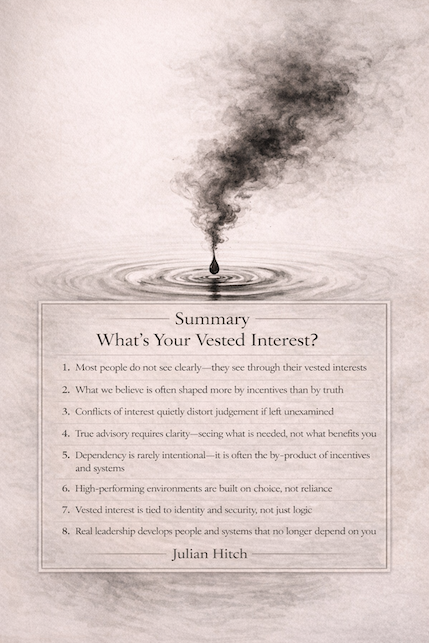
What’s Your Vested Interest?
There is a phrase, often attributed to Upton Sinclair, that has stayed with me for many years:
“It is difficult to get a man to understand something, when his salary depends on his not understanding it.”
It is a simple line, but it reveals something quite uncomfortable. One of the things I think is missing in modern life is the ability to step outside of our own vested interests. In particular, to see clearly, not just what benefits us, but what is actually true, what is needed, and what serves the whole.
And yet, there is an immediate tension here. When we are influencing people, the first thing you are taught is the opposite. You are taught to think: what’s in it for them? Not what you want, but how you give people what they want or need. If you want to move people, you must understand their motivations, their fears, their incentives.
So we find ourselves in a paradox. On the one hand, effective influence requires alignment with another person’s interests; on the other, integrity requires the ability to detach from your own. The art is holding both without distortion.
This becomes more important the more senior your role becomes. There is a perspective in the Tao Te Ching that has always resonated with me - the idea that the highest form of leadership is like water, flowing to the lowest place, serving all things without needing recognition. In more practical terms, I often think of it like maintaining a infrastructure system. It is not glamorous, it is not visible, but it is essential. And when it fails, everything fails. The role is not to be seen; the role is to ensure that things work.
That, to me, is a useful frame for leadership, for advisory work, and even for being an employee within an organisation. Your role is to improve things, to help the organisation grow, to support the people within it, and ultimately to leave it better than you found it. Whether that is 10%, 20%, or 100% depends on the context. But the aim is not to become attached to the role itself. It is not to become dependent on the paycheck. And this is where it becomes difficult, because we all have needs, responsibilities, and the realities of living in a modern world.
This is also where one of the biggest problems arises: conflicts of interest. What is best for the client, or the organisation, is not always what is best for you. And if you are not conscious of that, it will quietly shape your thinking. You see it everywhere. For me, it particularly prevalent in the advisory world. And the question is – can you give advice that is best for the other person but not be for you?
That does requires a level of separation. Not detachment from care, but clarity in thinking. The ability to notice when your perspective is being shaped by what benefits you, rather than what is actually needed. From my observation this seems to be a dying skill – and something we could all do with refreshing.
No-one is perfect, but to give an example of this. I always saw my role at Leon (and other organisations) as making my circumstances redundant. At Leon I was to implement the best wellbeing strategy, to help the organisation grow, to support the CEO and the wider team. And there is a natural point at which, if you have done that well, your role is complete - or at least needs to evolve. The aim is not to stay somewhere because you need to, but to stay because there is still value to create. Without drawing a too philosophical view (or that strong a comparison!), the concept is a little like the book The Prophet by Kahlil Gibran, who came, shared his wisdom, helped it embed and then left people to live it for themselves. Nothing lasts for ever – and often suffering happened is in trying to make things last that have passed.
Loyalty vs Dependency
There is, of course, a contrast here. We do want loyalty. We want to create environments where people can stay, grow, and develop over time. That continuity matters.
And emotionally, we want people to stay. The people we work with are not abstract - they become a meaningful part of our lives. We spend time together, we go through challenges together, and naturally, attachment forms. But there is a balance here. You want people to feel valued, supported, and cared for -and at the same time, you want to build something that does not depend on them staying.
But what we do not want to create is dependency. Because dependency changes the nature of the relationship. It moves from collaboration to survival. From contribution to attachment. From choice to necessity. And when that happens, something begins to degrade. If you are interested in exploring this further its worth looking at the destructive relationship models described Karpman’s Drama Triangle which shows what happens when we get caught in co-dependency.
High-performing environments are not built on dependency. They are built on choice. The best people rarely need to stay - they choose to stay. And that creates a very different dynamic. The work, then, is not to make people reliant on you, but to continually create the conditions where being there remains the best option. That requires constant attention to standards, growth, and culture. It is harder to maintain, but it preserves both performance and integrity.
Unintended Consequences and Incentives
There is another layer to this, which is often missed: unintended consequences.
Incentives do not just shape behaviour in obvious ways - they shape it quietly, over time. We make decisions that feel right in the moment, that align with what is rewarded, visible, or what is expected. But without reflection, those same decisions can create outcomes we never intended.
Dependency is often one of them. Not because anyone set out to create it, but because the system made it easier than building capability. This is why understanding incentives matters. This is both at an organisational level, and personally. Now might be the time to ask: What is driving your behaviour? What is being reinforced? And where might that be leading, over time?
The Real Driver: Security and Identity
Finally, there is also something deeper underneath this: security.
Vested interest does not just sit at a rational level - it often connects directly to our sense of identity. We want to feel valued. We want to feel respected. We want to feel that we matter. And in many cases, our role, our income, and our position become tied into that. This is where it becomes difficult to see clearly. Because what is at stake is not just the outcome - it is how we see ourselves.
Which is why, when people talk about “working on yourself”, it can feel vague. But in practice, this is one of the clearest examples of what that means. It is the ability to recognise where your thinking is being shaped by a need for security, approval, or attachment - and to still see the situation as it is. In that sense, the work is not just external. It is internal. And without that, it is very difficult to operate as a truly effective advisor or leader.
So the final question is simple, but not easy:
Where in your life are you creating dependency - and where are you building people who no longer need you?
And, if you are in a leadership or advisory role, this may be one of the most important questions you ask this year.
Julian Hitch