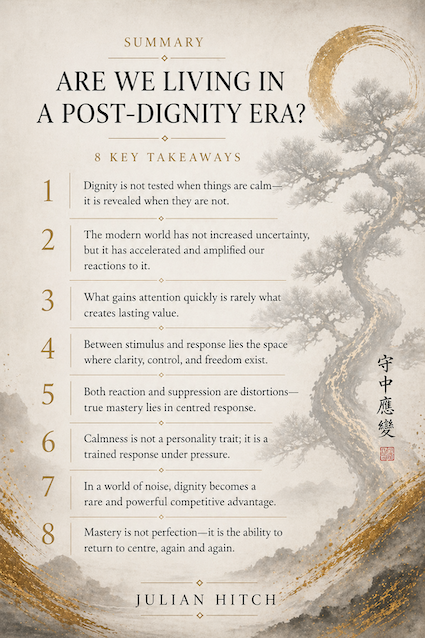
One of the qualities most consistently celebrated across cultures is the ability to remain calm and dignified, regardless of circumstance.
You see this in martial arts. In Wing Tsun, it is often referred to colloquially as the dignified art. And at the heart of it sits a simple but profound principle: respond, don’t react.
We wrote about this approach in Winning Not Fighting, but this is a universal idea. Faced with uncertainty, how do we act?
And perhaps the first thing to say clearly is that the world is not more uncertain than it has been before. It might feel it. But life has always been uncertain. What has changed is three main aspects:
· The speed of uncertainty.
· The visibility of our reactions.
· The incentives around attention.
Due to the internet and social media, we now live, in effect, on a permanent stage. This raises a more uncomfortable question:
Not just has dignity disappeared - but is it still rewarded?
And if it is not, where does that leave us?
One of the things I observed from my father’s era, being born in late 1920’s, was the quiet power of dignified silence. There was a weight to it and a restraint that came out of choice, not weakness.
Today, I am not convinced that is what we reward.
We appear, at least on the surface, to reward those who shout the loudest. Those who react fastest. Those who can command attention most immediately. And increasingly, cheap reactions are highly rewarded.
But what travels fastest is not always what is most useful.
These ‘loud’ responses signal identity quickly. They gain attention rapidly. They require little discipline. And they create the illusion of strength. But they come at a cost. They collapse nuance. They shorten thinking. And most importantly, they remove the space between stimulus and response.
These responses also create some kind of shallow addiction for those watching - always waiting for the next part of controversy, but never really feeling satisfied as we know ultimately we are just playing a game of ‘he said, she said’: fast opinions without substance. For those giving the opinions - it is like a ‘gilded prison’. A constant feeling of the need to create more content that ‘hooks’ and yet simultaneously knowing that it is never enough. What used to be known as the 15 Minutes of Fame has been compressed into a continual search for ‘5 seconds’ of fame.
There is also, however, a deeper cost here that is often overlooked. The cost of losing dignity is not just how you are seen - it is the standard you set for yourself, and the pattern you reinforce. So the question becomes practical when you see that in any given moment, we have three key options:
· We can react and escalate.
· We can suppress and internalise.
· Or we can process, and then respond.
Only one of these creates clarity. Only one of these tends to de-escalate. And only one of these builds mastery. As the famous summary of Viktor Frankl’s writing in Man’s Search for Meaning states:
“Between stimulus and response there is a space. In that space is our power to choose our response. In our response lies our growth and our freedom”
A loss of dignity does not just change how you are seen. It changes what you become comfortable being.
The power comes from the centre
There is, however, a subtle danger here that is often missed. That is that both ends of the spectrum can be weaponised.
Reaction without pause is clearly destructive, or at the very least sacrificing the long-term for the short-term. But dignity, when misunderstood, can become rigidity - silence without discernment, composure without questioning and compliance without standards. This is why the centre matters.
In Wing Tsun, we use the principle: the power comes from the centre. Both physically - in terms of the punch coming from the centre of your body - but also psychologically. It is your reference point under pressure. When things accelerate, the instruction is simple: return to centre. You draw the energy inward, regain clarity and act from there. It is also how you avoid the swing between suppression and reaction.
This is where martial traditions, across cultures, converge on something remarkably similar. They are not simply teaching techniques - they are teaching regulation:
· How to deal with stress.
· How to come out of it.
· How to increase your tolerance for it.
Without this, skill is unreliable - dependent on circumstances being in your favour. The Bushido tradition carried a phrase that, on the surface, sounds extreme: act as if you are already dead.
This is often misunderstood, but it is about removing the fear of loss.
And perhaps part of the challenge today is that we have become increasingly distant from death as a natural part of life. This, in turn, creates a pattern of behaviours – as what we avoid, we tend to fear. And what we fear, we rarely see clearly.
So when martial traditions speak about accepting death, they are not glorifying it. They are reducing its hold over our perception. When that fear softens, something else becomes possible: clarity.
Dignity is not a personality trait
You see this most clearly in those who have trained it. Calmness and dignity are not personality traits. They are trained perception and response under pressure.
When you look at experts in any field, this is one of the most consistent patterns. They do not simply feel less - they see more. And they respond differently. I have seen this repeatedly when working with senior leaders preparing for high-pressure interviews – whether television, radio, or difficult public conversations.
In those moments, the environment is often contrived. The questions are designed to provoke. The emotional framing can outweigh the rational one with the time to respond deliberately short.
What matters is not just what you say - but how you are seen.
Your ability to think clearly on your feet, to remain composed, and to respond rather than react becomes decisive. In that moment, you are not simply communicating information - you are demonstrating effortless control, gravitas and presence.
What is clear is that, over time, this ability is transferable. Once you train yourself to respond under pressure, it does not remain confined to one context:
- The talk for one hundred becomes the same as the talk for one thousand.
- The conversation in a room becomes the same as the interview on television.
- The discussion at board level becomes the same as the high-stakes negotiation.
The environment changes. The pressure changes. But your ability to respond calmly becomes consistent. What you are training is not the scenario - you are rewiring your nervous system.
It is this that gives you dexterity under pressure. Because ultimately, under pressure, people do not rise to their level of intention. They fall to the level of their training.
The purpose of martial arts was never simply combat. It was to expose individuals to pressure in a controlled way - so that when real pressure came, it was not overwhelming. Over time, this becomes more than a habit - it becomes a way of life.
Your response to stress shifts. Your window of tolerance expands. What once triggered you becomes manageable. And when you are pulled out of that state - as everyone is at some point - you develop the ability to return.
We saw this directly in the Kung Fu Barista programmes we ran at Leon Restaurants. By changing breath, movement, and awareness under pressure, we were able to shift not just internal states, but external outcomes - customer interactions, decision-making, speed, quality and composure in high-volume environments. Change the physiology, and you change the response.
This shows up in the smallest moments.
When you receive an email that frustrates you - do you respond immediately? Or do you pause? One of my father’s phrases was simple: least said, soonest mended.
Write it, if you need to. Get it out. But do not send it. Come back later or the next day, when you are back in control of your state. Expression and effectiveness are not the same thing.
Breaking the pattern of mirroring
This extends beyond written communication.
In customer service, for example, one of the most consistent patterns is our instinct to mirror. If someone is rude to us, the immediate impulse is to reflect that back. To match tone with tone, energy with energy.
But breaking that pattern is, in many ways, the difference between a professional and not. While it may not be fair - when someone is frustrated, emotional, or even aggressive - the responsibility to control our response does not disappear. If anything, it increases.
The ability to remain calm, to hold your ground without escalation, and to de-escalate the situation is not easy. But it is vital. Anyone can be calm when things are easy. Professionalism is revealed when they are not.
And this is what my father meant when he spoke about the old-school professions. Not status, title or qualification – but the ability to respond with composure when others could not.
There is also a deeper trade-off at play.
What gains attention quickly rarely builds anything that lasts - what is celebrated in the moment is often forgotten just as quickly. Mastery, by contrast, compounds. It is built slowly, often quietly, and rarely rewarded immediately - but it endures. Which is why dignity, in a world of noise, becomes a form of competitive advantage. Not because it is louder but because it is rarer.
And this brings us back to the question of reward.
If dignity is not consistently rewarded externally, then it must be grounded internally. Not in applause. Not in attention. But in a quieter question:
Can I stand by how I responded?
In law this is called the “Blush Test” – would you be embarrassed if your reactions were read out or seen in court? Because in your hardest moments, win or lose, that is the only thing that is truly yours.
Even then, you will not always get it right. No one does. There will be moments where you react too quickly. Where you move away from your centre. The question is not whether that happens - it is what you do next.
· Can you recognise it without judgment?
· Can you return to centre without ego?
· Can you be kind enough to yourself to learn from it?
Mastery is not built on perfection - it is built on returning. So perhaps we are not living in a post-dignity era. But we are living in an era where dignity is tested more relentlessly than ever before, and in a way that is less obviously rewarded. Which makes it both harder, and more important.
And perhaps that is the point. Dignity was never meant to be easy.
It was meant to be chosen.
Julian Hitch