Most people believe they are thinking. In reality, they are being thought.
One of the most interesting and, in many ways, overlooked, aspects of life is the role that thought plays in shaping our experience. Most people are unaware of just how much of their life is dictated by unconscious thinking.
But why does this matter?
It’s because it is a little like getting into a car and setting off on a journey, without really knowing where you are going, or how fast you are getting there - and yet still hoping that you will arrive somewhere you actually want to be.
The likelihood of that is low.
And yet, for many people, that is precisely how life is lived. Not consciously directed. Not clearly understood. Simply… unfolding, driven by something that sits just beneath awareness.
I remember very clearly the first time I heard the phrase: you are not your thoughts. It was not a gentle realisation. It was quite a shock. Because if that is true (and it is), then it raises a far more interesting question:
If I am not my thoughts, then what exactly is thinking, and how do I become aware of them?
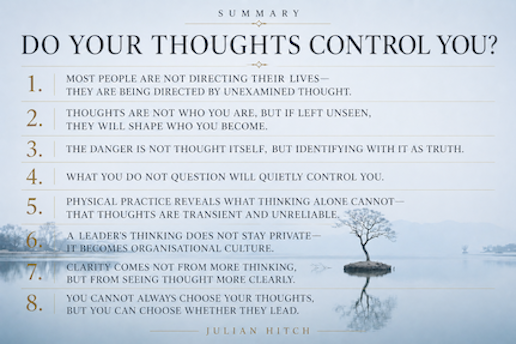
Thoughts arise constantly. They shift, repeat, contradict, and disappear. Some are useful. Many are not. But what becomes clear, if you observe them, is this: they are not stable, and they are not you. And yet, left unexamined, they will quietly dictate your life.
Most people think their way through life. Very few ever step outside their thinking.
The Thought Paradox
That is the paradox. Thoughts are not your essence, but they can very easily become your master. And perhaps that is why the old line remains so accurate: the mind is a great servant, but a poor master.
The issue is not thought itself. Thought, at its best, gives clarity, direction, structure. It allows us to plan, to reflect, to orient ourselves in the world. But when it is not understood -when it is not seen - it begins to lead in ways that are often invisible.
However, if you do not understand where your thoughts come from, then you are always vulnerable to being shaped by them, and more subtly, by others through them. Not necessarily in some deliberate or manipulative way. Often far more innocently than that. A comment from a parent. A teacher. An experience that lands more deeply than expected. Something said in passing that is never questioned.
And then, years later - sometimes decades later - it is still there, quietly influencing how you see yourself and what you believe is possible. And that’s not because it is true. But because it was never properly examined.
Making Conscious the Unconscious
So part of the journey, perhaps one of the most important parts, is bringing some level of consciousness to those unconscious drivers. Because until you can see them, you cannot really question them. You cannot test them. And you cannot change your relationship to them.
And this is where things become interesting.
There is an old Chinese wisdom: in motion, stillness; in stillness, motion. It points to something subtle, but very real. Even when you are physically still, there is movement -thought, reaction, memory, anticipation. And even when you are in motion, there is the possibility of stillness - awareness, observation, a kind of quiet clarity that sits behind the action.
The aim is not to stop thinking. That is neither realistic nor particularly useful. The aim is to see thought clearly enough that you are no longer entirely governed by it. And this is one of the reasons physical disciplines matter so much.
I personally use Wing Tsun, but there are many paths into this. Running can do it. Climbing can do it. Other martial arts can do it. Breathwork can do it. What matters is that there is something that takes you beyond the purely cognitive, because otherwise you remain within a closed loop: your thoughts thinking about your thoughts, analysing themselves, justifying themselves, reinforcing themselves.
What physical movement gives you is another reference point. It gives you experience. It allows you, even briefly, to see thought from the outside, or at least from a little more distance.
This is, in part, why Wing Tsun has been described, at its essence, as enlightenment through physical movement. Movement as a mechanism to reveal what is there, reveal what changes, and reveal what is conditioning you. And it reveals, often quite quickly, that thoughts are far less solid than they appear.
You see this very clearly in something as simple as Siu Nim Tao, the first form of movements in Wing Tsun meaning - the Way of the Little Idea. You perform it once, and thoughts arise. You perform it again, and they are different. You come back an hour later, and the entire experience has shifted.
So what does that tell you?
That thoughts are temporary. That they are inconsistent. That they are not necessarily true. And yet, at the same time, that they can still have a very real influence on how you feel, how you move, how you interpret what is happening.
They are revealing.
They show you what is there in that moment. And over time, they begin to show you patterns - deeper patterns in how you see yourself and the world.
I remember teaching online during COVID and asking a student how she felt after performing the form. She said she felt clumsy and inelegant. And it was interesting, because from my perspective, she moved well - she was coordinated, and there was nothing objectively clumsy about what she was doing.
So I asked her a simple question: Is that true, or is that a thought?
And after a pause, she said, “My parents told me I’d never be a ballerina.”
And there it was.
A thought - or perhaps more accurately, now a belief - that had been sitting there for years, quietly shaping how she experienced herself in that moment. When we brought some awareness to it, and she performed the form again, the experience changed almost immediately. This time she felt controlled, smooth, powerful.
Nothing external had changed. Only her relationship to the thought.
And this is where something even more subtle begins to show itself. The real difficulty is not just that thoughts arise - it is that we so often identify with them. We take them to be us. The moment you identify with a thought, you stop examining it - and start defending it. And the moment that happens, something shifts. Our objectivity narrows. Our adaptability reduces. Our ability to hear opposing views diminishes. What was once simply a thought becomes a position to defend.
And from there, it is a short step to rigidity, to fragility, and, at its extreme, to a kind of quiet hubris - where we are no longer examining our thinking, because we believe, in some sense, that we are it. The ability to see a thought as a thought, not as identity, is therefore not a small thing. It is what allows you to move around it, rather than be trapped within it.
You cannot always choose your thoughts. They arise. They come from places you are not always consciously aware of. But you can begin to choose whether they lead.
There is a line from Zhuangzi that captures this beautifully: The perfect man uses his mind like a mirror - it grasps nothing, it refuses nothing, it receives but does not keep.
And there is something very similar in the Diamond Sutra, which speaks of all conditioned phenomena as being like a dream, an illusion, a bubble, a shadow. Not meaningless. But not fixed. Thoughts sit very much in that space. They matter and they influence. But they are not the whole.
Clarity of Thoughts in the Leadership Space
Understanding thoughts is not just a personal point. It becomes very real in leadership and in business.
If you do not know who you are - as a person, or as an organisation - then you are very easily shaped by whatever is loudest around you. Trends, pressure, opinion. You react rather than respond, and you are swayed when you need to be focused.
At LEON, this was one of the deeper lessons. There was no such thing as a “healthy fast food” category before 2004. That had to be created. And that only happens when there is enough clarity not to be constantly pushed off course by the noise of the moment.
And this is where it becomes more subtle.
A leader’s unexamined thoughts rarely remain private. They become part of the organisation. They shape who is hired, what is tolerated, what is rewarded, what is avoided, how conflict is handled, how risk is understood, and what people believe is possible.
In that sense, the leader’s inner world becomes the outer culture. I often find myself asking senior leaders fairly simple (but not easy) questions:
Why do you think that?
Where does that come from?
Where else do you see that pattern?
And is it actually true, or is it just familiar?
Part of the role of a good advisor is to understand both the power of thoughts - and its limits. For instance, if the leader is driven by fear, the organisation is likely to become cautious. If the leader is driven by ego, the organisation becomes political. But if the leader is driven by clarity, the organisation has a chance of becoming clear. At this point, it goes beyond personal freedom and becomes about collective consequence.
When you know this, you start to see that many decisions are not made from clarity. They are made from inherited thinking - from things that have been repeated often enough that they begin to feel like reality.
I remember watching a respected professor during COVID say, “We think… we hope… we believe…” And it struck me, because those are not facts. They are interpretations - much nearer the language of philosophy and religion - and yet they were being delivered with authority.
It is a useful reminder of how little we are actually taught to examine the structure of our own thinking, despite the fact that it underpins so much of what we do. And this is where, particularly in the West, we have narrowed things. We have come to equate rational thinking with intelligence, and intelligence with the ability to live well.
But life is not purely rational.
And thought, on its own, is too narrow a frame to fully engage with it. It is an imperfect filter, shaped by memory, conditioning, emotion, and bias. Wing Tsun also points to something else here - the idea of the three minds: head, heart, and gut. Each with its own intelligence. Each with its own bias. And the issue is not that we have a preference, but that we are often run by one at the expense of the others.
So the opportunity is not to reject thought, nor to follow it blindly. It is to explore it, to see it clearly, to use it when it is helpful, and to recognise when it is not. And then, gradually, to develop other ways of engaging with the world - through experience, through awareness, through the integration of those different intelligences. The more ways you can see, the more clearly you can act.
So perhaps the real questions are quite simple:
Are your thoughts true?
Are they useful?
Where do they come from?
And are your thoughts controlling you?
And what are you doing, in a practical sense, to change your relationship with them?
How can you see a little more clearly, hold a little more lightly and, from time to time, step outside the thoughts that once felt like the whole of you?
Knowing that thoughts can be useful. They can also be useless. They can guide you, or they can control you. They are a tool - but they are only one of the ways in which we navigate the world. Because even that small shift creates space.
And in that space, there is something that feels a little closer to freedom. You cannot always choose your thoughts. But you can choose whether they lead.
And perhaps that is the final point:
Thought is part of the answer. It was never the whole.
Julian Hitch