One of the biggest competitive advantages in life is your ability to learn fast - and to act on what you learn.
And at the centre of that is your ability to listen. This is not a new topic. Listening is communication 101, conflict management 101, good business and leadership 101. But there is a deeper question that most people miss. This article could just as easily be called: What are you missing? Because the real question is not whether you listen. It is what you are actually listening for - and what that choice causes you to overlook.
When we hear the word “listen,” we assume it means the same thing. It doesn’t.
- Are you listening for what is being said, or how it is being said?
- Are you listening for meaning, emotion, pattern, or detail?
- Are you listening to build understanding, or to be right?
- Are you listening to respond, or to see clearly?
- And, importantly, are you listening for intent?
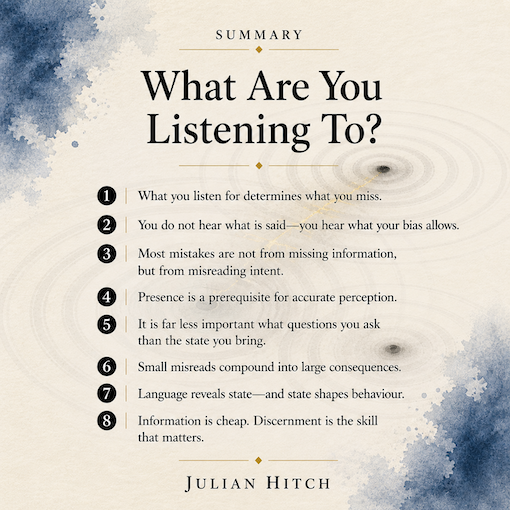
Each of these produces a different version of reality. The difficulty is that most people are not aware of the filter they are applying. We all have a bias in how we listen, and that bias determines what we hear. What you listen for determines what you miss, and what you miss determines the decisions you make.
In Wing Tsun, this is not theoretical. It is trained. Because most of the time, when people listen, they are already full. Full of what has just happened, full of their assumptions, full of what they think they know. There is a Zen idea of emptiness - not as nothing, but as availability. You arrive present, alert, but not pre-filled. You are there to receive what is actually in front of you, not what you expect to be there.
High Stakes Listening
This becomes very real in combat. What someone says and what they do are often not aligned. Someone may tell you they mean no harm while stepping forward with intent. They may threaten you while already withdrawing. They may create a distraction - something obvious to draw your attention - while the real action happens elsewhere. In training, we call this a dummy. It is there to give you something to react to. And if you over-commit to it, you miss what is actually happening.
What you are developing is not just accurate responses, but perception under pressure. The ability to see clearly without being pulled into the wrong signal. What we train is a form of focused relaxedness. You are precise in your attention, but not tense. You are open enough to take everything in, without being captured by any one thing. If you are too tight, you miss it. If you are too loose, you drift. The balance is clear, but relaxed.
The same principle applies in business, particularly as you move into more senior roles. Most people walk into meetings carrying the residue of the last one. They are physically present, but mentally elsewhere. And at that level, the stakes are higher and the environment more complex. You are rarely dealing with one agenda; there are usually several, and they are often competing. So the first question is not what the meeting is about. It is why you are there, and what you are listening for.
Are you trying to assess whether something is viable? Are you looking for alignment, or the lack of it? Are you trying to understand what someone truly believes, or whether they are simply reflecting someone else’s position? These are not the same task, and they require different forms of listening. This is where most people fail. They assume it is about asking better questions. It isn’t. It is far less important what questions you ask than the state you bring. If your state is off, your questions will not save you.
The cost of listening to the wrong signal
I have seen this go wrong. A CEO once optimised for ambition - listening for energy, drive, progression. What was missed were the underlying signals: behaviour that created division rather than cohesion. The trait itself was not the issue; the interpretation was. He wasn’t wrong about ambition. He was wrong about what it was attached to. And the cost of that misread was significant, both financially and culturally. Leaders rarely fail because they do not listen at all. More often, they fail because they listen for the wrong thing.
I have seen the opposite as well. Leaders so focused on detail that they miss the substance entirely. They will correct a minor error, a misplaced word, a small inconsistency, and in doing so overlook the intent, the direction, the underlying reality of what is being presented. Again, this comes with significant financial and cultural consequences.
In Wing Tsun, this teaching tells you that there are two aspects to develop. The first is presence. That means having a way to reset between interactions, to actually close one conversation before entering the next. It can be simple - a walk, a breath, a stretch, making a cup of tea - but it needs to be deliberate. Otherwise, you carry everything forward, and your ability to listen degrades without you noticing. Presence is rare, and because it is rare, it is powerful.
The second is awareness of how you listen. A simple test is this: after any important conversation, ask yourself what they actually meant, and what you reacted to. That gap - between meaning and reaction - is where most errors sit. Information is now cheap. Discernment is not.
The Hidden Language
Language provides so many hidden signs when you are aware of them. Ask someone how something felt, and if they respond, “I think…”, they have moved into their head. If they say, “I was worried…”, they are in emotion. The words reveal the state, and the state tells you where they are.
You can often hear this immediately, even over the phone. The way someone says hello carries information - their tone, their pace, their energy. You can sense whether they are open, guarded, distracted, or engaged. We all recognise this instinctively, which is why in good customer service you are trained to smile appropriately when you speak. You can hear the smile. Listening, in that sense, is not purely cognitive. It is embodied, even when the other person is not physically present.
And this is where it becomes useful. If you can read where someone is quickly, you can adjust in the moment. You can decide whether this is the right time to have the conversation, whether you need to shift their state, or whether you need to change your approach. These are not large interventions. They are small adjustments, made early. But they change the outcome. What begins as perception becomes action, and over time that becomes discernment.
Finally, it is worth recognising that listening is not one skill. It is a set of skills, and they need to be applied differently depending on the situation. In Wing Tsun, we speak of three centres - the head, the heart, and the gut. Three ways of knowing, three ways of listening. Part of mastery is understanding which one you are using, which one you need, and whether they are aligned.
So the question is not simply whether you are listening. It is what you are listening for. Because small misreads at this level do not stay small. They compound - into decisions, into culture, into trust. And by the time the cost becomes visible, it is rarely where the mistake began.
And most of the time, the mistake was not in what was said - but in what you chose to hear.
Julian Hitch