One of the biggest drivers in my life has been mastery.
Mastery is a fascinating concept because, strangely, we do not currently have a good modern definition for it. We confuse mastery with skill, status, output, achievement, or expertise. Even the dictionary definitions usually describe mastery as someone being highly competent at something or having control over a particular skill.
But for me, that misses the deeper point entirely.
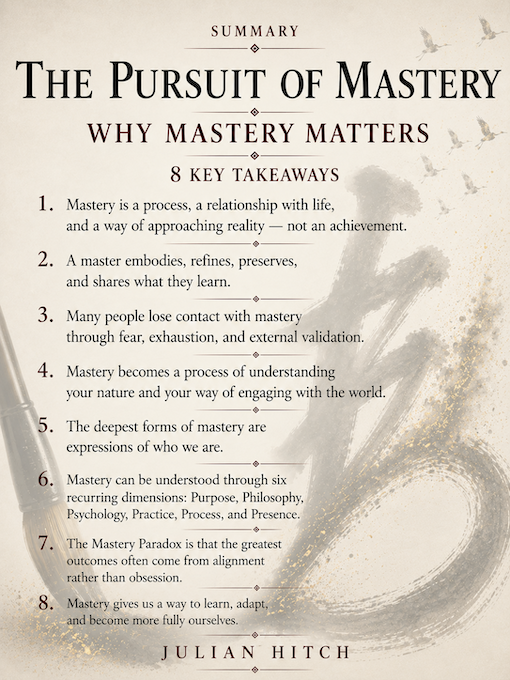
Mastery is not merely an outcome. It is a process. A relationship with life. And a way of approaching reality.
And that distinction matters enormously because if we reduce mastery purely to outcomes, then we misunderstand the very thing that creates them.
We also tend to confuse mastery with the idea of “a master”, which is related, but different. A master is not simply somebody who is highly skilled. A master is someone who continually practises mastery, embodies it, and ultimately carries a responsibility to preserve and share it with others.
These definitions matter because mastery underpins almost everything about how we look at life.
Mastery as a human driver
Mastery is one of the deepest human drives we possess, although many people lose contact with it over time. The passion for learning becomes tainted by fear, status, exhaustion, survival, external validation, institutionalisation, or simply the pressure of modern life. Eventually, many people stop expressing what is deepest within themselves.
That is where the real tragedy begins. And its something I wish to address here – as reclaiming it can begin with surprisingly small steps..
Mastery through martial arts
First to give you the context of the lens through which I view mastery.
My understanding of mastery came foundationally through martial arts, in particular Wing Tsun Kung Fu, where mastery is seen as the highest expression of martial arts themselves.
But even here martial arts are very easy to misunderstand.
You can look at Wing Tsun purely as the science of self-defence. You can look at it purely as a moving meditation. You can look at it as system for self-development. Or you can look at it purely as artistic expression and movement.
But Wing Tsun truly walks the centre line between all of them.
It is practical because life is practical. It teaches realistic engagement with pressure, uncertainty, fear, aggression, timing, emotion, adaptability, and consequence. But simultaneously, it is also deeply artistic because every movement ultimately becomes an expression of the individual using it. For many people it becomes deeply meditative, creating space for awareness and self-understanding.
And that is where mastery starts becoming difficult to describe.
Because eventually mastery stops being about simply becoming better at something. It becomes about understanding yourself. And understanding:
· Your nature.
· Your energy.
· Your patterns.
· Your blind spots.
· Your strengths.
· Your fears.
· Your way of engaging with the world.
And then continually refining all of it.
There is something unbelievably beautiful about that process. The continual curiosity. The continual learning. The continual adaptation. And the willingness to remain open whilst simultaneously building stronger foundations.
Mastery as an expression
For me, mastery is almost one of the most spiritual things a human being can pursue - not in a religious sense, but because it concerns the deepest questions of meaning, expression, growth, contribution, and self-knowledge.
It is about discovering what is deepest within you and learning how to express it more clearly through your actions, your work, your craft, your relationships, and your life.
You can see this in great martial artists, but you can also see clearly in musicians, craftsmen, writers, entrepreneurs, teachers, leaders, and artists. But it is not profession specific. It is also not limited to individuals - you can feel it in certain companies as well.
The best companies feel alive because they are continually learning and adapting whilst remaining deeply connected to who they are. They know what they stand for. They know their purpose. They know their philosophy. They evolve without losing themselves.
You could feel this inside LEON Restaurants - and we wrote about this in our book Winning not Fighting and how it positively impacted everything we did (and as a result the results we saw).
One of the reasons people became so passionate about LEON was because there was genuine meaning embedded into the culture. We genuinely cared about creating healthier fast food. Not performatively. Not as a branding exercise. Genuinely.
There was care in the food. Care in the experience. Care in the mission. Care in the people.
And when people feel genuine meaning and development inside a company, something changes psychologically. The culture feels different. The energy feels different. The consumer feels it. The employee feels it. The company develops a kind of aliveness.
Mastery changes the feel of things.
You also see this in artists when they talk about their work. I once heard Quentin Tarantino say that “the pen is the antenna of God.” Whether you interpret that spiritually or metaphorically is almost secondary. The deeper point is that at certain moments of mastery, people stop feeling like they are forcing expression. Instead, something flows through them. There is lightness and presence to it. The skill disappears into expression.
And I think this points towards something very important: Part of our purpose in life is to express the unique combination of capacities that exists within us. Despite how it might feel at times, it is not to become identical or simply imitate others. But to discover what is deepest within ourselves and bring it into the world as fully as we can.
The consequence of disconnection
When people disconnect from mastery, I often notice two things happen.
The first is jadedness.
Because life is difficult. And there is always the temptation to take shortcuts. In some systems, ruthless traits can absolutely be rewarded in the short term. Manipulation, aggression, politics, narcissism, deception, domination, and force can sometimes produce rapid external success.
But there is also a profound problem hidden inside that path. Even if you “win”, there is often an emptiness to the victory because deep down you know the win was not built through refinement, contribution, growth, meaning, or genuine capability. You simply forced your way through reality.
And secondly, it rarely creates true longevity.
“Live by the sword, die by the sword” as a phrase exists for a reason. When people rise primarily through force, manipulation, or fear, they often create environments of distrust, resentment, instability, and paranoia around themselves. And it’s likely to mirror the same tactics back. Even when they succeed externally, there is often very little peace underneath it.
Mastery, by contrast, is slower. But it is deeper and longer.
It develops capability without hollowing out the individual. It creates resilience without requiring constant aggression. It allows growth whilst remaining connected to meaning, contribution, and humanity.
Now, I am not claiming mastery is easy. In many ways, it is simple. But simple does not mean easy.
In fact, mastery may be one of the most difficult things a human being can genuinely pursue because it requires honesty, patience, humility, adaptation, responsibility, self-awareness, and sustained engagement over long periods of time.
This is why, over the last twenty-seven years, I have gradually developed what I call the Six Ps of Mastery. Of course, mastery is bigger than any model – but I have found six recurring dimensions that help us gain deeper insight into it.
The Mastery Paradox
During this process I realised there is a paradox sitting at the heart of mastery: you achieve the greatest outcomes precisely by not obsessing over the outcomes themselves.
In modern language, people sometimes say: “Focus on the inputs, not the outputs.” There is truth in that. But mastery goes deeper still.
This is because mastery is really about orientating yourself correctly. It is about aligning your purpose, philosophy, psychology, practice, process, and presence over time.
The Six Ps of Mastery
1. Purpose: The first expression of Mastery is purpose.
Purpose is the direction through which your meaning, energy, and potential are expressed. Mastery helps you both discover your purpose and increasingly live it through your actions.
It is the deeper orientation of your life and attention. It gives meaning to effort and direction to growth. Without purpose, practise and discipline eventually become hollow.
2. Philosophy: the second aspect of Mastery is Philosophy.
This is the principles, values, and worldview through which you interpret reality and orient your actions.
It shapes how you define success, respond to adversity, navigate uncertainty, and make decisions. Without philosophy, practice becomes reactive, fragmented, or driven purely by ego and external validation. It is both a guide for your decisions and an expression for how you want to live your life
3. Psychology: the third part of Mastery is Psychology.
Psychology is the inner operating system through which you perceive, think, feel and respond. It governs your relationship with identity, emotion, challenge, motivation, feedback and growth.
4. Practice: the fourth dimension of Mastery is Practice
Practice is your repeated embodied engagement through which your skill, understanding, and capability are developed.
Practice is not merely repetition. It is conscious interaction with reality. Through practice, ideas become embodied, feedback becomes tangible, and growth becomes earned rather than theoretical.
5. Process: the fifth characteristic of Mastery is Process.
Process is the systems, blueprints and feedback loops through which your practice continuously improves. Mastery helps you build a process that turns experience into continual learning.
Reflection, experimentation, correction, coaching, adaptation, and refinement all sit within process. Practice develops skill; process improves the way you practise.
6. Presence: the final element of Mastery is Presence.
Presence is the quality of awareness and attention you bring to the present moment across time. Presence is conscious engagement with reality. It is the ability to learn from the past, fully engage with the present, and simultaneously build toward the future. Presence sharpens perception, deepens learning, improves adaptability, and allows action without unnecessary internal conflict.
Mastery as a navigation tool for life
Mastery does not miraculously change your life to all ‘sunshine and rainbows’. Life will still contain uncertainty, loss, failure, setbacks, pain, confusion and periods where things do not go to plan.
No one escapes that.
What mastery gives us is not immunity from difficulty, but a way of engaging with it.
A way of learning.
A way of adapting.
A way of remaining open without becoming broken.
A way of refining ourselves through the process of living.
And perhaps that is why mastery matters so much. Because in the end, mastery is not really about becoming better than other people.
It is about becoming more fully yourself.
Julian Hitch