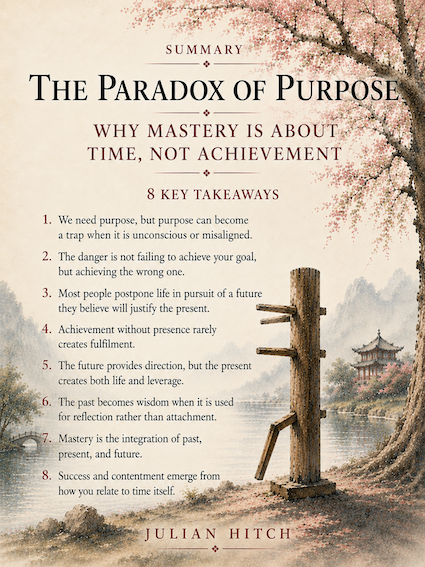
One of the great conundrums of life is that we need purpose.
Without a sense of direction, movement, or meaningful pursuit, life can quickly become flat. There is a restlessness that emerges in human beings when we feel we are drifting. We are not built simply to exist. We are built to move towards something.
And yet, this creates a paradox.
Because the very thing that gives life direction can also become the thing that steals life from us. If our purpose is misplaced - if it is unconscious, inherited, poorly chosen, or built around the wrong reward - we can spend years, even decades, in pursuit of something that, when it finally arrives, does not justify the life we lived to reach it.
The real risk is not failing to achieve your goal - it is achieving it, and finding it was not worth the life it required.
This is why you hear the same reflections, again and again, from those who have “made it”: It was never really about the money; The victory fades quickly; The moment you thought would change everything lasts a day - if that.
The problem is not ambition itself, but the relationship we build with it.
The Hidden Error in How We Pursue Purpose
Most people attempt to solve fulfilment through the future. They place meaning somewhere ahead of them: A role. A number. A milestone. A recognition. And in doing so, they make a quiet trade:
“I will tolerate the present in order to reach the future.”
Sometimes, this is necessary. There are moments in life where short-term sacrifice for long-term gain is both rational and required. But this logic has a breaking point.
Because if the present is consistently something to be endured rather than experienced, then life itself becomes something you are postponing. You are not living - you are waiting. And at some point, the future you are chasing becomes the present you have created. If that present is not aligned, the result is simple:
You arrive… and feel nothing.
Achievement without presence rarely creates fulfilment.
Mastery as the Resolution
Mastery resolves this paradox - not through abandoning ambition, but through refining the relationship with time itself. It does this through a simple, but not easy discipline: the integration of past, present, and future. Most people treat these as separate. Masters do not.
They understand that each has a role - and that fulfilment and effectiveness come from how they are held together.
Future: Direction Without Dependency
The future matters. You need to know where you are going.
Without direction, your effort becomes scattered. Your energy dissipates and progress becomes accidental. But the future is not where fulfilment lives. It is where direction lives.
The moment the future becomes the sole source of meaning, you create dependency - and that dependency creates fragility. Your sense of self is now tied to something that does not yet exist.
Present: Life and Leverage
The present is both your life and your leverage. It is your life, because it is the only thing you are actually experiencing. Whatever else exists beyond this, we know with certainty that we have this experience.
And it is your leverage, because it is the only place where anything can be influenced.
Everything you will become is being shaped here. Everything you will achieve is being built here. And yet, this is the place most people neglect - because they are mentally elsewhere.
Mastery offers something different. It offers immersion.
To be fully in what you are doing - not a passive presence, but active engagement. This isn’t always pleasant, but it is the point of control. When you begin to enjoy the process of the present something shifts within you. You stop chasing the future - and start building it.
Past: Learning Without Attachment
The past is your teacher. It holds feedback, patterns, mistakes, and insight.
If you ignore the past, it leads to repetition. Yet, if you overweight it, it leads to hesitation and stagnation. Mastery sits between the two.
You look back - not to dwell, but to extract:
• What worked?
• What didn’t?
• What is the pattern here?
• What principles are still relevant to learning today?
• How can I use the past to make learning faster, easier and deeper?
And then you return to the present - better informed, more precise, more effective. This is where compounding truly happens. And interestingly, this is more than time alone - it is reflected time.
The Loop of Mastery
When these three are integrated, something powerful emerges.
The future provides direction.
The present provides action and experience.
The past provides refinement.
And the cycle repeats continuously as a way of operating, approaching and navigating through the unknown that is life.
The Centre Line of Energy
There is another useful way to understand this mastery of time through both performance science and ancient Wing Tsun principles. And this is the spectrum of energy.
At one extreme, there is too little demand - which leads to boredom, stagnation, drift.
At the other, too much - which leads to stress, pressure, and eventual burnout.
Optimal performance, and what many would recognise as flow, sits between the two. This is often described through the Yerkes–Dodson Law.
There is wisdom within this - and something I’ve observed personally with clients. I have seen individuals who have achieved what most would consider complete freedom - financial security, autonomy, the ability to go where they want, when they want. And yet, without direction or meaningful engagement, they begin to deteriorate. Not dramatically but quietly. Without something to apply themselves to, there is nothing to organise their energy and nothing to draw them forward.
And at the other end, I have seen people so fixated on an outcome that they sacrifice the experience of their own life in pursuit of it. They are productive, but absent. Driven - yet disconnected.
Both paths lead to the same place: Misalignment.
In Wing Tsun, we describe this as ‘losing the centre’. The discipline is not to eliminate effort or ambition - but to place them correctly. You want to find the point where challenge is sufficient to demand growth, but not so dominant that it removes presence. It is where you are fully engaged without either drifting or forcing.
A Personal Reflection
One of the reasons we set the world record for continuous aerobic training (36 hours and 5 minutes) was not actually because we sat down and decided we wanted a world record.
The reality was much simpler than that.
One day I had been teaching and training from morning through until midnight. Private lessons in the morning, seminars during the day, discussions and theory at lunch, more training, more teaching, evening classes and then finishing late into the night.
I remember getting to the end of the day and thinking: “That was brilliant. I would love to do more of that.”
Then the thought naturally followed: “I wonder what the world record is?”
That was how it began.
Not because I was suffering in the present for a future reward. Not because I was enduring something I disliked in the hope that one day I would feel fulfilled. It emerged because I was deeply immersed in what I was doing already.
The future became an extension of the present. And that distinction matters because one path is driven by escape and the other by engagement. One continually delays life. The other allows life and achievement to grow together.
The Modern Trap
Contrast this with something I have seen many times in individuals and organisations.
Someone is in a role they do not particularly enjoy, but they tell themselves it is temporary because they are working towards something beyond it. A promotion. More money. Greater freedom. A future that they believe will eventually justify the sacrifice.
And again, there is nothing inherently wrong with this.
Life often requires short-term discomfort for long-term gain. There are periods where we need to push, where we need to stretch ourselves, and where we accept trade-offs because we believe something meaningful sits on the other side of them.
The question is not whether sacrifice is necessary. The question is: when does the short-term become the medium-term, and when does the medium-term quietly become your life?
Many people wake up years later to realise that what was meant to be a stepping stone became the road itself. And sometimes the destination arrives and the reward simply does not justify what was given away to reach it. This is partly why I speak so much about systems, culture, and structure. There is enormous value, growth, and learning available in almost any role if there is alignment. Some organisations describe this as ‘dream matching’ - understanding what someone wants from their life and seeing how that can align with what the organisation itself is trying to achieve.
At their best, organisations do not simply extract effort - they help people align what they are doing with who they are becoming. And when that happens, something changes. The present stops becoming something to endure and starts becoming something that builds both fulfilment and future success at the same time.
The Foundational Question
Most people look for fulfilment in the future. Masters solve it through how they relate to time itself. So the question is not simply:
“What are you aiming for?”
Instead, it is:
How are you relating to your past?
How are you using your present?
How are you directing your future?
In that temporal relationship lies both your success - and your experience of life itself. If you miss this, you may achieve everything you set out to - and yet still miss your life.
Julian Hitch