Do You Create Leaders or Followers?
There is a fundamental question every teacher, manager, and senior executive must confront:
What is your ultimate aim as a leader - dependence or empowerment?
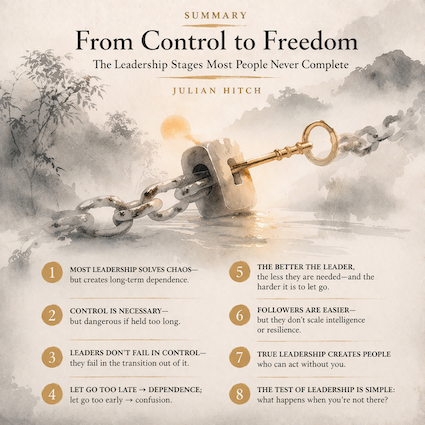
It sounds simple. Almost obvious. And yet, in practice, it is one of the most misunderstood principles in leadership. Most leadership creates followers, not leaders. And that is where the problem begins - and leads to very different outcomes. Because if people still need you - to decide, to move, to act - then something hasn’t been completed. Not in them, and not in you.
This reflects something powerful I have seen first-hand from the most effective, and least effective leaders. And that is those that are able to develop others, have first been able to develop themselves. And those that fundamentally don’t trust others - well, you might not be surprised to know that they were lacking in similar self-trust. This is because the deeper question is this:
How many of us have actually been taught how to empower ourselves - let alone empower others?
The challenge is that most people are never taught how to empower themselves - let alone others. At best, it is learned by chance: through the right environment, the right pressure, or the right example. For many, it isn’t learned at all. And so what we default to, often without realising, is something else entirely:
Control.
This is not necessarily in a negative sense, but as a starting point. Control people in an aim to reduce chaos and create movement. And to be clear, control has its place. Without it, particularly at the beginning, nothing functions. There is no structure, no shared understanding. But this is where the first mistake happens. We mistake control for leadership. Because what control does is solve the problem of chaos in the short term. However, over time, it creates a new problem:
Dependence.
And this is where most leaders fail - not in control, but in the transition out of it. They either hold on too long, creating dependence, or let go too early, creating confusion.
The paradox is simple: The better the leader, the less they are needed - and the harder it becomes to let go.
People begin to look to you - whether that’s for answers, for permission, for direction. And if that becomes the norm, what you create are not leaders, but followers. This also locks up your talent - who rather than spending their time finding solutions instead expect you to find it for them. So you both become locked up in co-dependant, energy and training draining spiral.
This situation also comes down to a philosophical view. What do you believe is more important - people follow what you say? Or that they are capable of leading in their own way?
Now theoretically, particularly in companies, the answer is obvious. We say we want empowered people. People who can make decisions, learn from mistakes and adapt quickly. Because we know that the speed of learning and growth, particularly in modern environments, is essential.
And yet, if you look more closely, you see a different pattern. When you study organisations, or even empires, there is a constant movement between centralisation and decentralisation. Authority is pulled in… and then pushed out again. You saw this in the Soviet Union - the swing between control and distribution of power. You see it in large organisations and franchises: quality drops, so control is brought back in-house. Then scale becomes difficult, so it is pushed back out again. The pattern repeats because the tension is always there.
So the question becomes: How do you actually do this well?
At LEON, this was something we thought about deliberately (and later wrote about in Winning Not Fighting). John, as CEO, was very clear and visionary in how he approached this.
For instance, we had simple principles: Be kind. Be a leader. Live and Eat well.
Those values weren’t just words, they shaped how we acted and how we thought about people. For instance, we didn’t see restaurant managers as operators. We saw them as CEOs of their restaurants with the head office as the ‘Support Office’ - as their role was to support the functioning of the restaurants, not dictate to them.
Similarly, the team members were empowered to make the right decision for the customers without having to first get approval from the managers. If a person’s food had gone cold - like in one legendary case where a mother with a child had to go to the bathroom - they would simply swap out the food and give her a fresh one when she returned.
This reframing changed behaviour - when someone sees themselves as a leader, they act differently. Decision-making accelerated. Ownership increased. Standards rose and became embodied.
The Hidden Trap: The Desire for Followers
I know all too well from teaching martial arts for over 25 years that the deadly temptation is to create followers. And in the short-term it is far easier. Followers are predictable. Followers are controllable. Followers reinforce your authority.
But they come at a cost - they don’t scale intelligence, resilience or create legacy. A true master does not create dependence. They create other independent masters. The aim is to have a system that allows individuals to think, adapt, and ultimately surpass you. In many ways, the role of the master is to create freedom in others.
But that does not happen by accident.You have to be able to see where someone is, understand what they need, and guide them forward - often without them fully realising it at the time. Lao Tzu said it best:
“When the best leader’s work is done, the people say: ‘We did it ourselves.’”
Leadership Modes of Development
At this point, it helps to understand leadership is not a binary. It is a progression - and a discipline. It is a set of modes that is situational, adaptive and requires discernment. Every mode serves a purpose but creates a limitation if not used appropriately.
Leadership Modes of Development
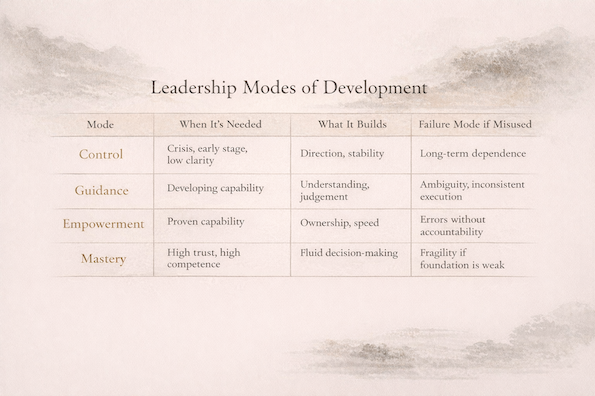
The role of a leader is not to sit in one of these. It is to know when to move between them.
In Wing Tsun, we describe development through what we call the Four Doors - a progression of learning and depth. What’s interesting is that as people move through those stages, their ability to move between these leadership modes also evolves. The deeper the understanding, the less rigid the approach.
However, intent alone is not enough - you need a mechanism. This is why the starting point is always the same: Know yourself.
If you understand who you are - your strengths, your tendencies, your biases - then you stop trying to be something you’re not. From that place, you can begin to develop authentically with far less effort.
In organisations, this has to be built into the system. For instance, at GrowUp Farms, we used psychometrics from the point of recruitment. This was not as a label - but as a way of understanding: Where are people starting from? How do we help them see themselves more clearly? Without that, a lot of development is guesswork.
And once you understand that, the next question becomes: How do you actually create leaders?
How do you help people:
• learn effectively
• build capability
• take decisions
• understand risk
• know when to act - and when to check in
This is where a real system matters, and in my opinion, an understanding of mastery. Because without a way of developing people, empowerment is just an idea. So there are really two questions underneath all of this:
Where do you sit?
• Do you actually believe in developing leaders?
• Or do you, perhaps unconsciously, prefer followers?
And secondly:
What is your mechanism?
• Do your systems build independence - or dependence?
• Do they create alignment - or enforce compliance?
And finally, and perhaps most importantly:
What happens when you’re not there?
Because in the end, leadership is not what you say. It is what you allow others to create.
Julian Hitch