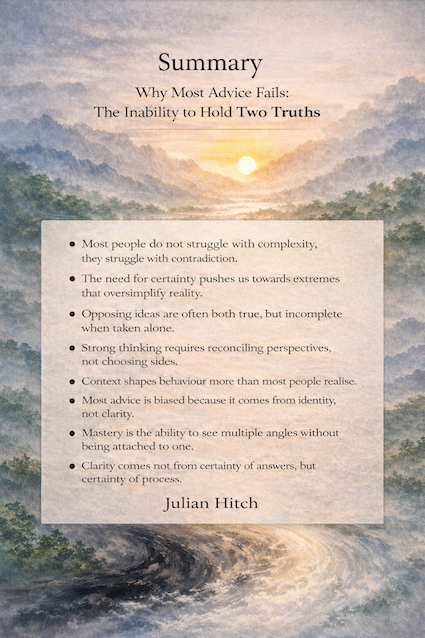
Most people do not struggle with complexity. They struggle with contradiction.
With this comes a fundamental question - whether in leadership, business, or life:
Can you hold two opposing ideas at the same time, without collapsing into either?
Because most people cannot. Not through lack of intelligence, but through a need for certainty. Human beings like to label, to categorise, to decide quickly what something is and then defend that position. It gives a sense of control. The difficulty, of course, is that life rarely fits neatly into those categories, and so what we tend to do instead is move towards extremes.
Take a company. On one side, you will hear that the purpose of a business is simply to make money, and people exist to facilitate that. There is truth in this. A company that does not make money does not survive. It is not unkind or unreasonable to recognise that viability matters. In fact, it would serve every employee well to understand the value they create. Indeed, as a rough commercial rule of thumb, that value often needs to significantly exceed cost - sometimes by a multiple such as four times -once you factor in overhead, risk, and the wider system. While this doesn’t apply in every situation, it generates an important question: what value am I actually adding? Without that question, organisations often fall into a familiar cycle of over-hiring, then firing, then over-hiring again, never quite understanding where the imbalance lies.
On the other side, you will hear that it is all about the employee. And that if someone is not happy, the work itself is somehow invalid, or they are being exploited. Again, there is truth here. People do need to feel engaged, to have meaning in what they do, to feel that their effort matters. So this generates an important question: what is our culture or system missing? But taken to its extreme, this too becomes unhelpful, because responsibility cannot sit entirely on one side. The company must create the conditions, but the individual must also take responsibility within them.
So which is correct?
Both are true, and both are incomplete when taken alone. What is required is not the selection of one over the other, but their reconciliation. In the example above, an organisation is not a collection of isolated parts, but something closer to a jigsaw. Every function, every individual, every role exists in relationship to something else. The question is not simply, “Is this person performing?” but “How does this part support the whole, and how does the whole support this part?”
This is the principle in Buddhism called the Middle Way, and what in Wing Tsun we call The centreline. It becomes the ability to hold both truths fully and allow them to inform each other.
The Seduction of the Extreme
This pattern is not limited to business. It is how we tend to think about most things.
Extremes are compelling. They create emotional. They sell. But they rarely reveal truth. As the Tao Te Ching points out, “when people see some things as beautiful, other things become ugly; when people see some things as good, other things become bad.” The act of labelling creates the division we then believe to be real.
And so we judge quickly and we reduce complexity. We categorise people as good or bad, right or wrong. But if you look more closely, what you tend to find is something more uncomfortable and more useful: people are rarely one thing. They are a blend. Behaviour shifts depending on context, environment, pressure, and experience.
There is a considerable body of research which shows how quickly behaviour can shift depending on conditions. Studies such as the Stanford Prison Experiment and the Milgram Experiment demonstrate that ordinary people, placed under certain pressures or roles, can act in ways they would not normally consider. Not because they are fundamentally bad, but because context exerts a powerful influence. And more modern behavioural practitioners, such as Chase Hughes, also emphasise how rapidly behaviour can be influenced by environment, perception, and framing.
So if that is true, then the role is not to rush to condemnation, but to understand the forces at play. Because it is only from that place that you can influence change. Condemnation closes the door. Understanding gives you options.
The discipline, then, is to learn how to see more.
The Advisor Trap
This becomes even more important when we consider how we advise others, because here there is a subtle danger. Most people give advice from identity. Very few give advice from clarity. They speak from what they would do, what has worked for them, what aligns with their own values and experiences. And whilst that can be helpful, it is not neutral. It is shaped by bias, whether acknowledged or not. So advice must be given with caution, because until you are able to see the situation more fully, how do you know whether your input is supporting what is needed, or quietly distorting it?
There is also a deeper problem here, which sits underneath much of this, and that is the conflation of identity with thought. We do not just have opinions. We become them.
You see this very clearly in areas such as sales, where it is often effective to move someone into identification. To get them to say “you,” to see themselves in the picture, to feel that the outcome is theirs. It is powerful, and it works, because human beings are driven by identification.
But that same mechanism, which is useful in persuasion, becomes a limitation in judgement. Because as soon as you identify with a position, it becomes much harder to see beyond it.
And this is where the role of the advisor becomes fundamentally different. An advisor cannot afford to be wedded to a single viewpoint. They cannot afford to identify with one side and defend it. They must be able to step outside of that entirely, to see multiple positions, multiple benefits, multiple risks, and to understand how each of those shifts depending on the situation.
That is not easy. In fact, if you look around, very few people are capable of it. Most are attached, to some degree, to their perspective, their belief, their experience, and they defend it, often without realising they are doing so. What they call conviction is, at times, simply attachment.
And that, in many ways, is the discipline. Not to have no views, but to not be owned by them. This is why most advice fails – not because it lacks intelligence, but because it lacks perspective. Now might be the time to reflect: What type of advisor are you?
Clarity through movement
In Wing Tsun, we develop this skill through movement. In the second form, Chum Kiu, you develop the ability to step and to see from different angles, from the front, from the side, from the back. Later, as you progress into the third form, Biu Jee, it includes from above and below. This is not only physical. It is a way of thinking. It is a way of training perception. You begin by asking where your bias is, why you think what you think, but perhaps the most important question is the one that disrupts certainty: what have I not seen?
In combat that question can save your life. And in life generally that question alone, if asked honestly, will take you further than most answers.
There is a progression that comes with this. At the beginning, you are certain of everything. Then, as you begin to see more, your certainty drops, because you realise how much complexity there is. Many people get stuck here, in doubt. But if you continue, something changes. You do not arrive at certainty of answers, because life does not allow that. Life is unknown. What you arrive at instead is certainty of process. You trust how you look at things. You trust how you question. You trust the way you arrive, even whilst knowing the answer itself may change.
There is a Zen expression which captures this journey well, often attributed to Qingyuan Weixin:
Before practice, a mountain is a mountain and a river is a river;
During practice, a mountain is no longer a mountain and a river is no longer a river;
And after realisation, a mountain is once again a mountain and a river is once again a river.
The mountain has not changed, but the way you see it has. And that, ultimately, is the point. We speak of something similar in Wing Tsun, particularly in the later stages of training. In Biu Jee, there is the idea of the mountain, of standing at height and looking down across the landscape. Many people can stand on that same mountain, but they will not all see the same view. Position alone does not give perspective. Perception does.
And so perhaps the real question is not simply whether you can argue both sides, because that can be done intellectually without depth. The deeper question is whether you can genuinely hold two opposing viewpoints without needing to reduce one of them for your own comfort. Can you stay with the tension long enough to see how they connect? Can you feel emotion without being ruled entirely by it? Can you think clearly without becoming detached from what is human?
Because the difference between reacting and responding is not speed, but perspective. And perspective is earned through the discipline of seeing more than one side.
So the process becomes a practical one for you:
Where in your life are you defaulting to extremes?
Where are you choosing certainty over understanding?
And what might change if, instead of rushing to an answer, you asked a better question: What have I not seen?
Julian Hitch