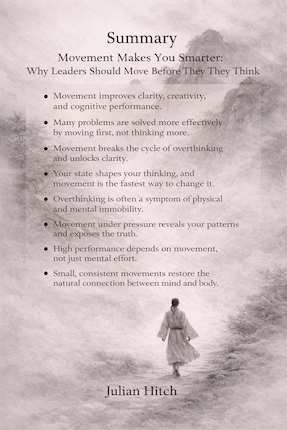
Why Movement Makes You Smarter:
Some of my best decisions have never come while sitting still.
They arrived while moving
When the body moves, something in the mind opens. Problems become clearer, creativity increases, and insights appear that stubborn thinking alone could not produce. Put simply, physical movement improves brain function - which is one of the reasons martial arts training can make you think more clearly and creatively.
Over the years I have come to see that this is not accidental. Movement does not merely strengthen the body. It changes how we think. In fact, when I advise leaders trying to solve complex or challenging issues, the first step is often to ignore the common approach - think more. You actually need to move first, and let the solutions come to you - as contrarian as it seems.
This is not just about wellbeing. It directly affects the quality of your decisions. In Wing Tsun Kung Fu we sometimes describe this as enlightenment through physical movement - the idea that through movement we understand ourselves, our reactions, and the world around us more clearly.
One of the reasons martial arts training is so powerful is that movement improves brain function, creativity, memory, and decision-making. In Wing Tsun, the purpose of training is not simply about combat effectiveness and self-defence. It is about changing your whole experience of life and developing clarity and insight through movement.
This is not a modern discovery. For thousands of years, civilisations recognised that physical movement and intellectual clarity are deeply connected. The body and the mind are not separate systems; they are one.
The Roman poet Juvenal wrote: “Mens sana in corpore sano” - a healthy mind in a healthy body. Aristotle went further, warning that prolonged inactivity degrades both body and mind.
Modern life, however, has moved us away from this. Many people now spend most of their day sitting. Our bodies were simply not designed for prolonged inactivity. Humans evolved to move – to walk, run, and endure.
When we don’t, several things begin to happen:
Blood flow reduces, particularly to the brain
Posture collapses
Breathing becomes shallow
Muscles become inactive
The nervous system becomes less alert
All of this reduces our ability to think clearly.
Why Movement Improves Brain Function
Modern neuroscience supports what ancient cultures understood: movement changes how the brain learns and processes information. Exercise stimulates Brain-Derived Neurotrophic Factor (BDNF), which supports learning, memory, and neural growth.
In simple terms, movement strengthens the brain. But there is another important effect. Movement often breaks the loop of overthinking. When the body moves, the mind tends to follow with greater clarity. Overthinking is often a symptom of immobility.
Movement is also one of the fastest ways to change your state - and your state determines how you think, decide, and respond.
This is why many people find that their best ideas come while walking, training, or exercising. The body, in many ways, unlocks the mind.
Movement, Truth, and Performance
There is another layer to this.
Movement exposes truth. Under pressure and in motion, you cannot hide behind overthinking. Your patterns reveal themselves.
This is one of the reasons martial arts are such a powerful vehicle for self-understanding. You begin to see your reactions clearly - hesitation, tension, overcommitment, avoidance. And once seen, they can be refined.
When we talk about high performance, this is one of the most underrated aspects. Even if you don’t care about wellbeing, if you care about performance, movement is fundamental.
Movement in Practice
This understanding shaped some of the work we did at Leon Restaurants, where I served as Director of Well-Being.
We experimented with bringing movement into the culture of the organisation. One initiative was the Kung Fu Barista Programme, which introduced elements of movement and physical awareness into training.
In leadership workshops and senior team meetings, we often began with movement rather than sitting. This helped people become present, shift their state, and connect more effectively.
We also introduced simple practices:
Walking meetings
Rebounders (mini trampolines) such as Bellicon
Natural movement sessions with practitioners like Tony Riddle
Encouraging short bursts of activity throughout the day
None of these ideas were complex. They simply recognised something fundamental: human beings are designed to move. In Wing Tsun we summarise this principle very simply: breathe less, move more.
The Quiet Foundation of Mastery
Movement does not have to mean intense training. Often it is the small movements, the micro-movements, that matter most.
Standing more. Walking more. Stretching between tasks. Taking the stairs. Holding meetings while moving rather than sitting.
These small shifts accumulate. They restore the natural rhythm between mind and body that modern life has disrupted. As Wing Tsun teaches, movement is not just about becoming stronger, but becoming more aware, more responsive, and more present.
It is one of the quieter foundations of mastery. And over time you realise something quite profound: When the body moves well, the mind often follows.
The question becomes a simple one:
Where can you add more movement into your day?
Julian Hitch